
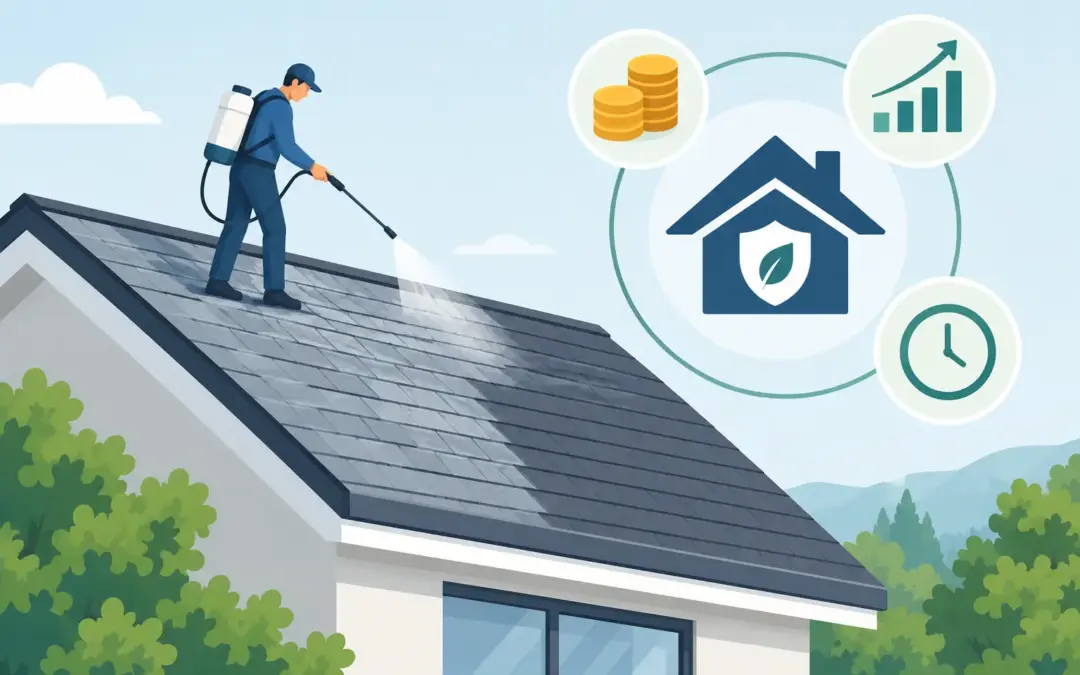
A roof can appear faded, dry, and worn years before it reaches the point of complete failure. That gap is where smart property decisions are made. This guide to roof treatment economics explains how homeowners and roofing professionals can evaluate restoration against replacement based on condition, timing, risk, and long-term value.
For an aging asphalt shingle roof, the lowest immediate quote is not always the lowest-cost decision. Replacing a roof too early can discard years of usable service life. Waiting too long can expose the home to leaks, interior damage, and emergency costs. The better question is simple: what option protects the existing asset at the best overall cost?
The Real Cost of an Aging Roof
Roof replacement is a major capital expense. Beyond materials and labor, homeowners may face tear-off charges, disposal fees, decking repairs, permit requirements, landscaping protection, and disruption to daily life. If the roof is still structurally sound, replacing it solely because shingles look weathered can be an expensive response to a problem that may be manageable.
At the same time, ignoring visible wear is not a strategy. Asphalt shingles gradually lose the oils that help them remain flexible. As they dry out, shingles can become brittle, shed granules, lose color, and become more vulnerable to weather. Granule loss is more than a curb-appeal concern. Those granules help shield the asphalt layer from ultraviolet exposure.
Roof treatment economics begin with recognizing that not every aging roof needs the same answer. A roof with widespread active leaks, major storm damage, failing decking, severe shingle loss, or end-of-life structural issues may need replacement. A roof that is weathered but intact may be a candidate for restoration that extends its functional life.
Compare the Full Financial Picture
A fair comparison between treatment and replacement should look beyond the invoice amount. Homeowners should consider the cost today, likely future costs, remaining roof life, property appearance, and the consequences of delaying action.
A professionally applied rejuvenation treatment can cost substantially less than full replacement because it works with the roof that is already in place. Rather than removing and replacing the entire roofing system, a treatment is designed to restore flexibility in aging asphalt shingles at a molecular level. When the roof qualifies, that can help reduce granule loss, revive color, and preserve the value of the original installation.
The key economic advantage is timing. Extending the useful life of an existing roof can postpone a large replacement expense and give a homeowner more control over when that future investment occurs. That matters when a homeowner is balancing other priorities, such as remodeling, tuition, retirement planning, or unexpected repairs elsewhere on the property.
Replacement still has a clear role. New roofing may be the right decision when a roof cannot be safely restored, when underlying components have failed, or when the homeowner has a broader renovation plan that requires a complete roofing change. Roof treatment is not a shortcut around necessary repairs. It is a value-focused option for roofs that still have a sound foundation.
The Cost of Waiting Too Long
There is also a difference between strategic deferral and neglect. If an aging roof has not been evaluated, small maintenance issues can become expensive water-intrusion problems. Damaged insulation, stained ceilings, mold concerns, and deteriorated wood can quickly change the economics.
That is why condition assessment comes first. A qualified roofing professional should inspect the roof for active leaks, damaged flashing, missing shingles, soft decking, ventilation concerns, and other conditions that may affect eligibility. Treatment economics only work when the roof is a responsible candidate for treatment.
What Creates Value Beyond the Initial Savings
The financial case for roof restoration is strongest when it solves several problems at once. Homeowners often want a roof that looks better, performs better, and avoids a disruptive project. A properly selected treatment can support all three goals.
First, appearance has value. Faded shingles can make a home look older than it is, affecting curb appeal and the owner’s confidence in the property. Restoring richer color and a more uniform appearance can improve the visible condition of the home without the cost and waste of a tear-off.
Second, preservation has value. Shingles that retain or regain flexibility are better positioned to handle normal expansion, contraction, and weather exposure than brittle shingles. While no treatment can make an old roof new, preserving shingle performance can help a qualified roof deliver more value from the materials already installed.
Third, predictability has value. A five-year transferable warranty, when available through a certified applicator and subject to its terms, gives homeowners an added layer of confidence. Transferability can also be a practical talking point if the home is sold during the warranty period. Buyers often appreciate evidence that a visible exterior component has been professionally maintained.
A Practical Framework for Homeowners
Homeowners do not need to become roofing experts to make an informed decision. They need clear answers about the roof’s present condition and the likely cost of each path.
Start by asking whether the roof is structurally sound and free of conditions that require replacement. Then compare a treatment proposal with replacement estimates, while accounting for tear-off, disposal, repairs, and disruption. Finally, consider how long the treatment is expected to help preserve the roof and whether a transferable warranty is included.
It is also wise to ask what the service includes before treatment is applied. Surface preparation matters. A complete process may involve cleaning the roof, addressing appropriate pre-treatment conditions, applying the rejuvenating product evenly, and documenting the completed work. The quality of the application is part of the value equation, which is why certified providers matter.
Roof Shield’s proprietary biodegradable treatment is designed for this restoration-first decision: Clean. Restore. Protect. For eligible asphalt shingle roofs, it offers homeowners a practical way to preserve an existing roofing asset while reducing the material waste associated with premature replacement.
The Sustainability Side of Roof Treatment Economics
The economics of roofing are not limited to dollars. Every premature tear-off creates material waste, transportation needs, and landfill volume. Asphalt shingles are heavy, and replacing a roof before its functional life is exhausted has an environmental cost that is easy to overlook.
Restoration can reduce that burden by helping a viable roof stay in service longer. This does not mean replacement is environmentally wrong when it is needed. A failing roof must be addressed responsibly. But when a roof can be preserved, extending its life can be a more resource-conscious choice.
For many homeowners, sustainability becomes more compelling when it aligns with practical savings. Choosing a biodegradable treatment that helps maintain the existing roof can support both goals without asking the customer to compromise on quality or protection.
Why the Economics Matter for Roofing Businesses
For roofing contractors and home services professionals, roof treatment creates a different kind of opportunity. Replacement work will always be essential, but a replacement-only model can leave a gap for homeowners whose roofs are aging yet still restorable.
Adding a qualified restoration service gives a business a way to serve those customers instead of turning them away or asking them to make a replacement decision before they are ready. It can create a lower-cost entry point, generate referrals from satisfied homeowners, and establish the contractor as a trusted advisor rather than a single-solution salesperson.
The best business case is not based on overselling treatment. It is based on proper qualification. Contractors who can clearly explain when treatment makes sense, when repairs are needed, and when replacement is the responsible recommendation earn credibility. That credibility supports long-term growth.
Certified applicators also benefit from a differentiated offering that is not simply another commodity roofing quote. Protected territories, training, operational support, and lead-generation guidance can help a contractor build a distinct restoration category while delivering measurable customer value.
Make the Decision Before the Roof Makes It for You
The most expensive roofing decision is often the one made under pressure after damage has already occurred. Evaluating an aging roof early gives homeowners room to compare options, protect their budget, and choose the right level of investment based on real condition.
If the roof is a good candidate, treatment can turn remaining roof life into meaningful savings, improved appearance, and less waste. If replacement is necessary, an early assessment still provides the advantage of planning rather than reacting. Either way, a professional evaluation gives the homeowner something valuable: a clear path forward before a small concern becomes an urgent problem.