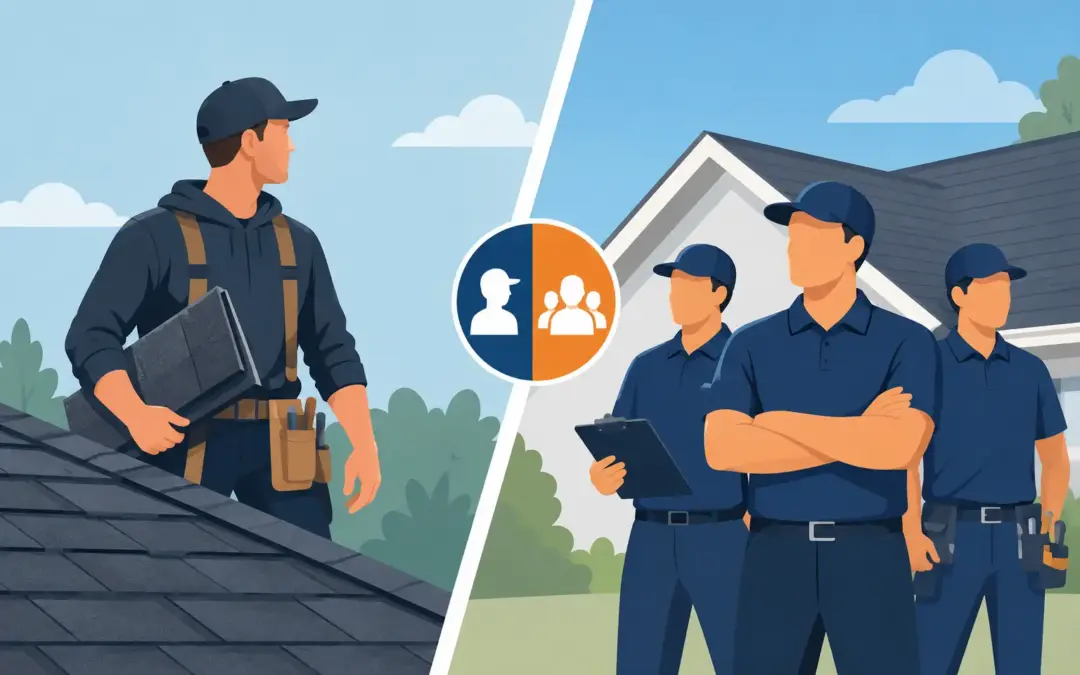
A homeowner with a weathered shingle roof does not always need a replacement estimate. They need an honest assessment, a credible restoration option, and a provider they can trust. For a business owner weighing an independent applicator versus roofing franchise, that customer moment reveals the real decision: how much control do you want over the service you deliver, the brand you build, and the revenue you keep?
Both paths can create opportunity. A franchise can offer an established operating system and recognizable name. An independent applicator model can give a contractor the freedom to grow an existing business while adding differentiated technology, specialized training, and protected market access. The better fit depends on your goals, your local market, and the kind of company you want to own five years from now.
What a Roofing Franchise Typically Offers
A roofing franchise gives an entrepreneur the right to operate under an established brand. In return, the franchisee generally follows prescribed procedures for sales, marketing, pricing, customer communication, vehicle branding, software, and service delivery. That structure can be valuable for someone entering the industry without a developed business foundation.
The central appeal is predictability. A franchise may provide onboarding, a playbook, promotional materials, and systems that have been used in other markets. Instead of developing every process from scratch, the owner can focus on applying a proven model locally.
That support usually comes with significant obligations. Franchise businesses commonly require initial fees, ongoing royalties, advertising contributions, renewal costs, and compliance with brand standards. Some also set expectations around approved products, supplier relationships, service areas, or pricing practices. Those requirements are not inherently negative. They are the trade-off for operating under the franchise banner.
For an established roofing contractor or exterior-services company, however, a full franchise model may be more restrictive than necessary. If you already have crews, customer relationships, local reputation, and a working sales process, rebuilding your business around another company’s brand can limit the equity you have worked to create.
The Independent Applicator Versus Roofing Franchise Decision
An independent applicator is not simply operating alone. In the strongest version of this model, the business remains independently owned while gaining access to specialized products, training, quality standards, operational guidance, and market support from a technology provider.
That distinction matters. Rather than replacing your company identity, the right applicator relationship can strengthen it. You can continue serving customers under your own business name while offering a service competitors may not have: a roof-restoration treatment designed to help aging asphalt shingles regain flexibility, reduce granule loss, improve color, and extend functional roof life.
For contractors, this creates a practical middle path between complete independence and franchise control. You retain ownership of your company, customer experience, and local reputation. At the same time, you gain a defined restoration process that can be presented with training, warranty-backed value, and professional consistency.
The right choice depends on what you need most. If you need a full business model, a franchise may provide more structure. If you already operate a capable roofing, cleaning, restoration, or home-services company, an applicator program may provide a faster way to add a high-value category without surrendering your business identity.
Control, Costs, and the Value of Your Brand
The financial comparison should go beyond startup cost. Ask what each model requires over time and what it allows you to build.
A franchise may require recurring royalty payments regardless of whether a specific job comes from franchise marketing or your own local efforts. You may also be required to use designated systems and campaigns. That can simplify operations, but it can reduce flexibility when your market responds differently than another territory.
An independent applicator model is often more compatible with an owner who wants to preserve their existing brand equity. Your trucks, local reviews, referral network, and sales relationships remain central to the customer experience. Instead of becoming one more branch of a national operation, you become the local authority offering a specialized solution.
This is especially meaningful in restoration. Homeowners want clear answers when their roof looks faded, brittle, or worn but is not yet at the end of its usable life. A contractor who can explain both replacement and restoration earns credibility. The conversation becomes less about pushing the largest project and more about recommending the right solution for the roof’s condition.
That credibility can lead to better relationships, more referrals, and broader customer lifetime value. A homeowner who avoids a premature replacement may later return for maintenance, cleaning, repairs, or eventual replacement when it is truly needed.
Support Without Losing Independence
Independence should not mean figuring everything out alone. Adding a new service category requires more than purchasing a product. It requires training, application standards, sales education, safety practices, warranty procedures, and a clear way to communicate value to homeowners.
A certified applicator network can supply that foundation while leaving room for local expertise. At Roof Shield, certified applicators receive access to proprietary biodegradable roof-restoration technology, structured support, and protected service territories. The goal is not to turn capable contractors into franchise operators. It is to equip them to offer a smarter alternative to replacement-first selling.
Protected territory access is particularly valuable when the service is differentiated. It gives an applicator room to establish local market awareness without competing against another certified provider across the same neighborhood. That exclusivity can support more focused marketing, stronger referral momentum, and a clearer return on the effort invested in educating customers.
Still, support does not eliminate the need for ownership. The most successful applicators bring local discipline to the opportunity. They train their teams, document inspections, follow the treatment process, respond quickly to leads, and make realistic recommendations. Technology creates the advantage, but professional execution creates the reputation.
A Better Customer Conversation Can Build Revenue
Traditional roofing revenue often depends on replacement, repair, and emergency work. Those services remain essential. But a restoration offering creates an additional conversation with homeowners who may not be ready for a replacement – financially, practically, or environmentally.
When a roof qualifies, restoration can provide a substantially more affordable path than replacement. It can help preserve the existing roofing asset, refresh curb appeal, and reduce the waste created when shingles are removed before their functional life is exhausted. For the homeowner, that is a practical decision. For the applicator, it opens a service category that can be scheduled efficiently and positioned around measurable customer value.
Not every roof is a candidate. A roof with major leaks, structural concerns, widespread damage, or shingles that have reached the end of their useful life may require repair or replacement. An applicator’s willingness to make that distinction is a business advantage, not a lost sale. It protects the customer and reinforces trust in the recommendation when restoration is appropriate.
The strongest sales process starts with inspection, not assumption. Assess shingle condition, granule loss, flexibility, roof age, visible damage, and overall suitability. Then explain the options in plain language. Homeowners do not need a technical lecture. They need to understand what condition their roof is in, what the treatment can reasonably accomplish, and how warranty coverage supports their decision.
Who Benefits Most From Each Path?
A roofing franchise can make sense for an entrepreneur who wants a complete, prescriptive system and is comfortable operating within firm brand requirements. It can also suit someone who has limited industry experience and values a standardized launch process over customization.
An independent applicator model is often a stronger fit for established roofers, exterior-cleaning providers, restoration specialists, and entrepreneurial trades professionals. These businesses already understand local customers and field operations. What they need is a differentiated service that creates new revenue without requiring them to hand over their brand or reshape their entire company.
Before choosing either path, look closely at the agreement, ongoing financial obligations, territory terms, training depth, lead-generation support, warranty process, and degree of operational control. Ask whether the model helps you build an asset that is truly yours. Also ask whether it gives customers something meaningful that they cannot easily get from the contractor down the street.
The most valuable business model is the one that lets you serve customers well while building durable local equity. If your company is ready to offer homeowners a cleaner, more affordable way to restore aging shingles, choose a partnership that helps you grow without asking you to stop being the business your community already trusts.